



What to see at the Giralda in Seville: a guide to ensure you don’t miss a thing
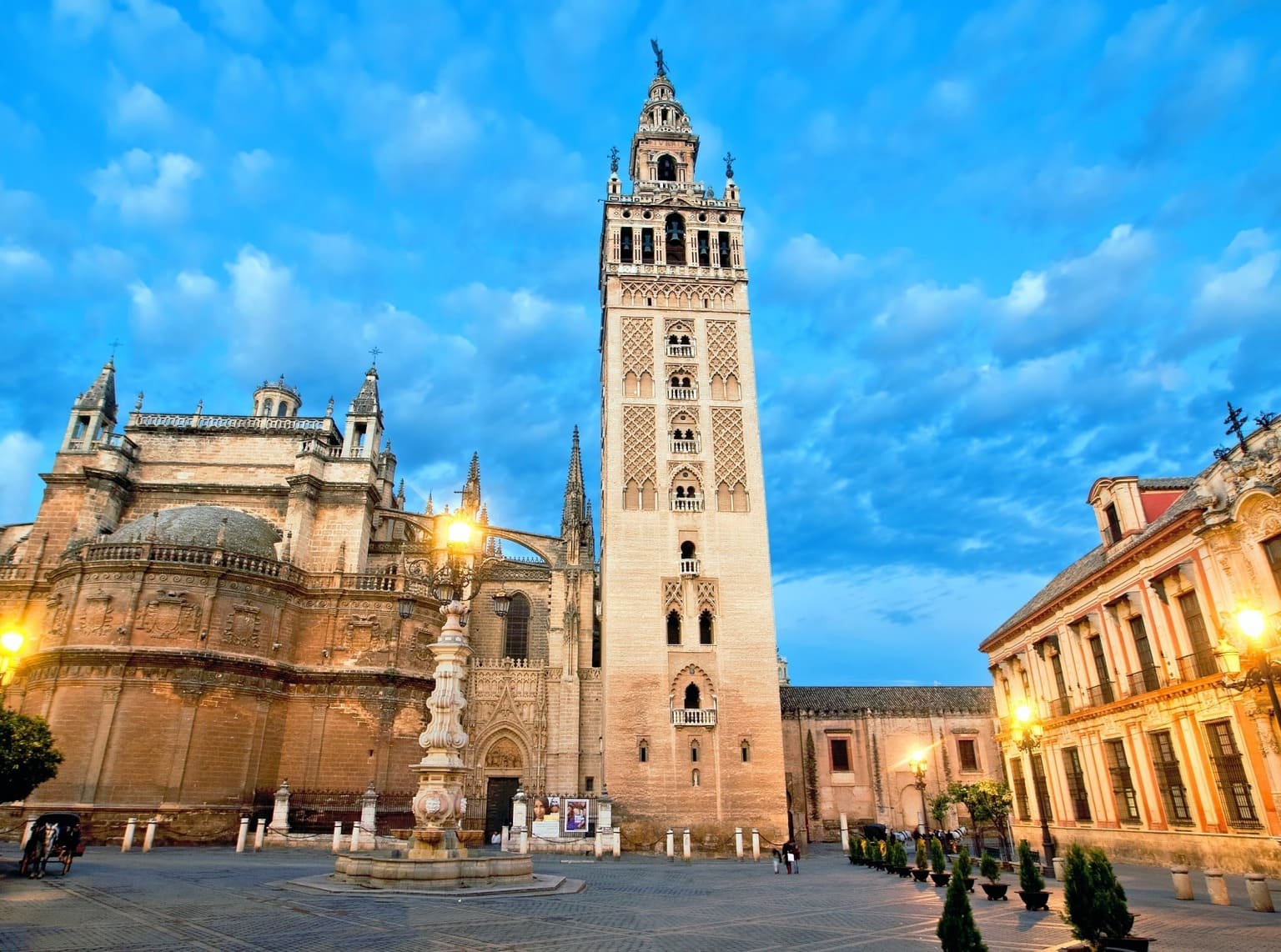
The Giralda is one of those monuments that practically define the image of Seville. Its silhouette rises above the rooftops of the historic centre and, although it is already impressive from the outside, climbing the tower gives you a much better understanding of why it is one of the city’s great symbols.
But what exactly is there to see at the Giralda in Seville? The visit isn’t just about getting to the top and enjoying the views. As you explore, you’ll discover a tower with a history that blends its Almohad past with the transformations carried out after the Christian conquest. What’s more, from the bell tower you’ll have a superb panoramic view of Seville’s historic centre.
Here’s everything worth knowing during your visit.
The Giralda in Seville: much more than just a bell tower
The first thing to bear in mind is that the Giralda forms part of Seville Cathedral. Its lower section corresponds to the former minaret of the main Almohad mosque, whilst Christian elements were subsequently incorporated, including the bell chamber and the Renaissance spire.
Construction of the minaret began in the 12th century. Its structure follows the classic model of Almohad minarets: a square tower with a central space, flanked by the ramps used to climb to the top.
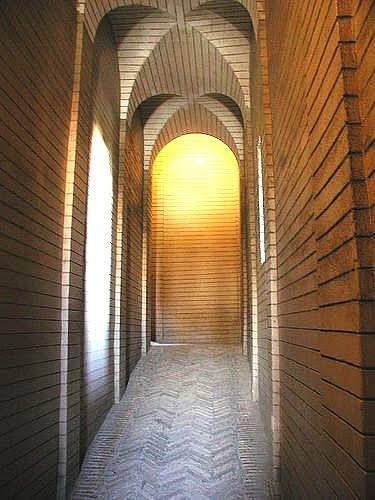
It is precisely these ramps that are one of the most intriguing features of the visit. Unlike many monumental towers, the main ascent is not via an endless narrow staircase.
The Cathedral itself explains that the dimensions of the ramps even allowed access on horseback to the upper parts of the tower.
When viewing the Giralda from the outside, it is also easy to distinguish its different historical periods. The decoration of the Almohad section includes the characteristic sebka panels and other geometric elements, whilst the upper section has a different aesthetic due to the Renaissance alterations.
For this reason, a good way to visit the Giralda is not to limit yourself to seeking out the viewing platform: the tower itself is the main attraction of the tour.
What to see at the Giralda in Seville
The ancient Almohad minaret
One of the key features is the original part of the tower.
The Giralda began life as the minaret of Seville’s former Great Mosque during the Almohad period. Much of the structure we see today dates from that medieval building.
Its exterior is characterised by the geometric decoration on the walls, particularly the sebka panels – those networks of rhombuses that have become one of the most recognisable features of Sevillian Almohad architecture.
The structure also allows us to appreciate how a tower of this size is organised. Inside is the central core, surrounded by ramps that rise progressively.
This architectural detail has a practical consequence: the climb is different from what many visitors expect when they think of climbing a tower nearly one hundred metres high.
The ramps of the Giralda
The ramps are probably one of the most intriguing aspects of the visit.
The ascent is mainly via a series of ramps rather than a conventional staircase. There are 35 ramps, originally designed so that the ascent could be made on horseback.
This does not mean that the climb is entirely straightforward. There is a significant elevation to overcome, and the incline remains steep for much of the way. However, the absence of a continuous staircase makes the experience quite different from that of other bell towers.
During the climb, it is also worth paying attention to the architecture itself. It is not simply a path to reach the viewing platform: you are walking through the interior of an Almohad building that has survived for centuries.
The bell tower and its bells
Upon reaching the top, one comes to the bell chamber, which was added during the 16th-century renovations.
It was Hernán Ruiz II who carried out work on the tower and created the Renaissance-style finial that now characterises its upper section. Seville Cathedral particularly highlights the large windows of the bell chamber, with arches and capitals of Caliphate origin.
It is here that the tower takes on the appearance we recognise today: a highly distinctive combination of the lower Almohad structure and the Renaissance elements situated at the top.
As well as admiring the architecture, from this vantage point another of the visit’s major attractions comes into its own: the views over Seville.
The Giraldillo
At the very top of the tower stands the famous Giraldillo, a bronze sculpture that serves as a weather vane.
It symbolises the triumph of the Faith and became the feature that gave the tower its popular name. The upper section was created during the 16th-century Renaissance restoration.
The Giraldillo is particularly recognisable when viewing the Giralda from the streets of Seville, but during your visit it is also worth learning about its history.
An interesting fact is that the piece currently crowning the tower is a replica, whilst the original Giraldillo is kept in storage following its restoration.
The views of Seville from above
And now we come to the moment many visitors have been looking forward to most: the views.
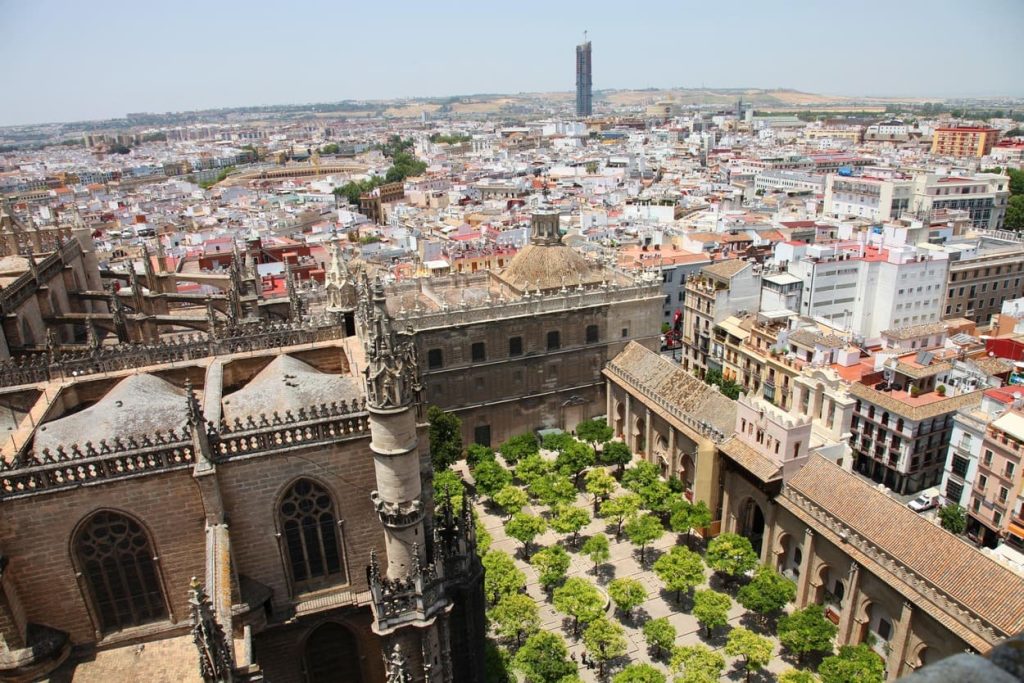
From the top of the Giralda, you get a superb panoramic view of Seville’s historic centre. Among the landmarks that can be spotted from above are the roofs of the Cathedral, the Real Alcázar, the Torre del Oro, the River Guadalquivir and the Triana neighbourhood.
You can also make out the Plaza de España area to the south.
The viewing platform isn’t particularly spacious, and the layout is dictated by the tower’s design itself, so at busy times you may have to wait to get a look from some of its sides.
If you want to enjoy the panoramic view in particularly pleasant light, we recommend visiting first thing in the morning or in the late afternoon, when the lighting is usually more favourable and there are fewer visitors.
What to see around the Giralda
One of the advantages of visiting the Giralda is that it is situated right in the heart of the historic centre and forms part of the cathedral’s complex of monuments.
For this reason, it doesn’t make much sense to think of a visit to the tower as something completely separate from the rest of the monument.
Seville Cathedral
The Giralda is the cathedral’s bell tower, so a visit allows you to explore both sites.
Inside the cathedral there are numerous points of interest, such as the High Altarpiece, the choir, the chapels, the Royal Chapel and various doorways. The tomb of Christopher Columbus is also located there.
If you have time, it’s best to allow plenty of time to visit the whole complex rather than just climbing the tower and leaving straight away.
The Patio of the Orange Trees
The Patio of the Orange Trees is another of the spaces linked to the complex’s Islamic past.
According to information from Visitanddo, together with the Giralda itself, it is one of the surviving elements of the former mosque complex.
It is also a good vantage point from which to view the tower from below and get a better appreciation of the exterior decoration of the former minaret.
The Gate of Forgiveness
The Gate of Forgiveness is another of the features you can include on your tour of the cathedral complex.
Thanks to the Giralda’s location, all these areas can be visited as part of virtually the same itinerary, without having to travel far.
How long does it take to visit the Giralda?
The time required will depend on whether you visit just the tower or take the opportunity to explore the Cathedral as well.
As a guide, a combined visit to the Cathedral and the Giralda can take approximately between an hour and a half and two hours, depending on your pace and how much time you spend in each area.
The climb up the tower on its own can be done in less time. We estimate the climb takes around 10–20 minutes, depending on each visitor’s pace.
Even so, it’s best not to treat the visit solely as a race to the viewing platform. Part of the appeal lies precisely in observing the structure, understanding its history and pausing at the various points along the route.
Is it worth going up the Giralda?
Yes, especially if it’s your first visit to Seville.
It’s not just about the panoramic view. Climbing the Giralda allows you to explore the interior of one of the city’s greatest landmarks and see how different historical periods have been incorporated into a single tower.
From the top, you’ll also get a different perspective of the historic centre. You’ll see the Cathedral from a prime vantage point and be able to spot some of Seville’s most important monuments and neighbourhoods.
The combination of history, architecture and views makes the climb worthwhile even for those who don’t usually spend much time visiting monuments.
Tips for visiting the Giralda in Seville
When is the best time to visit?
If you have a choice, the early hours of the day or late afternoon are usually good options because of the light and the smaller crowds compared to the middle of the day.
During peak season, it is advisable to book your visit in advance, as entry is subject to capacity limits.
What to bear in mind during the climb
Even though you won’t have to tackle an endless flight of stairs, the climb does require physical effort.
The ramps are continuous and there is a steady incline, so it’s best to take the climb at a leisurely pace.
You should also bear in mind that official and tourist information may change depending on the season, particularly regarding opening times, admission fees and access conditions. Before you go, it’s advisable to check the latest information from Seville Cathedral.
How to make the most of your visit to the Cathedral
The Giralda forms part of the Cathedral complex, and access to the tower is via the interior of the grounds. Therefore, if you are planning to visit both sites, it is best to organise your visit as a single tour.
A good idea is to explore part of the cathedral first, then visit the tower, and finish by enjoying the area around the Cathedral, the Patio de los Naranjos and the historic centre.
Frequently asked questions about the Giralda in Seville
How many metres high is the Giralda?
The tower is nearly 100 metres high.
How many flights of steps are there in the Giralda?
The climb consists of 35 flights of steps, plus the final section, which includes a few steps in the bell tower.
Can you go up the Giralda?
Yes. You go up via the cathedral and it forms part of the tour of the cathedral complex.
What can you see from the Giralda?
From the top, you can see the roofs of the Cathedral, the Real Alcázar, the Torre del Oro, the Guadalquivir, Triana and other parts of Seville’s historic centre.
What’s inside the Giralda?
You won’t find a museum or a series of rooms. The interior is dominated by the tower’s structure and the ramps leading up to the bell chamber.
What is at the top of the Giralda?
At the top is the belfry and, crowning the tower, the Giraldillo, the famous weather vane symbolising the triumph of the Faith.
Discover the Giralda and experience Seville from the heart of the city
Visiting the Giralda is much more than simply climbing one of Seville’s best-known monuments. It means taking a journey through part of the city’s history, discovering the Almohad legacy that still remains on its walls, and enjoying, from the heights, a privileged view of the historic centre.
And after exploring the Cathedral, losing yourself in the streets of the city centre and admiring Seville from the top of the Giralda, comes another of the great pleasures of travelling: having a special place to rest and continue enjoying the city.
If you’re looking for somewhere to stay in Seville, Casa del Poeta is the perfect choice for experiencing the city from a prime location. Its setting puts you close to some of Seville’s must-see attractions and allows you to continue discovering the charm of the historic centre on foot.
Because Seville isn’t just about visiting its monuments. You can also enjoy it by strolling at a leisurely pace, discovering its squares, sitting down for a drink on a terrace and returning to your accommodation after a day of sightseeing.
So, if you’re planning your getaway and have already added the Giralda to your list of must-see attractions, make sure your accommodation is part of the experience too. Discover Casa del Poeta and enjoy Seville from the heart of the city.
Sorry, the comment form is closed at this time.